It is the antibodies living cells enzymes and hormones that make breast milk ideal. The fat and lactose a type of carbsugar provide most of the energy in breast milk.
 Pin On Nutrition Science
There is an average of 12 g of fat per ounce.
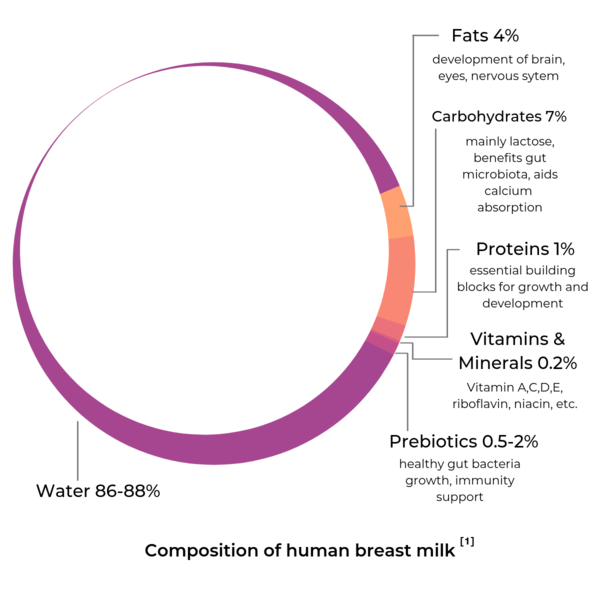
Breast milk nutritional value. Breastmilk gives complete nutrition. When researchers analyzed more than twenty studies of breast milk composition they calculated the following average values for milk expressed by women between 2 weeks and 6 weeks postpartum Hester et al 2012. Each 100 mL of breast milk produced within this time frame yields approximately 65 calories 67 g carbohydrates primarily lactose.
Breast milk is good for your baby in many ways. Your breast milk is 875 water 5. Also a ton of other molecules make breast milk more than just about nutrition.
It provides natural antibodies that help your baby resist illnesses such as ear infections. Theres no known age at which breast milk is considered to become nutritionally insignificant for a child. Energy 6612 kcal100 mLs fat 4014 g100 mLs protein 0904 g100 mLs and lactose 6607 g100 mLs.
The average amount of calories in breast milk is 75 calories per 100ml with the range being 50-120 calories per 100ml. These are of course averages. Breast milk contains about 7gdL lactose.
Calculations to show the nutritional value of breast milk in the 2nd year indicate that it may supply 13 of all protein needs. A new study from the University of Rochester indicates all the nutrients newborns need may not be found in donor milk. Calories in breastmilk average.
Human milk expressed by mothers who have been lactating for 1 year has significantly increased fat and energy contents compared with milk expressed by women who have been lactating for shorter periods. The presence of only 1 severely malnourished child in this group of children supports a protective nutritional effect of the breast milk. What are the advantages of breast milk over formula milk.
Breast Milk is calculated to be 65Cal per 100 grams making 80Cal equivalent to 12308g with 72g of mostly carbohydrates35g of fat11g of protein in 100g while being rich in vitamins and minerals such as Pantothenic Acid and Selenium. Its usually more easily digested than formula. Breast milk has the perfect combination of proteins fats vitamins and carbohydrates.
Lean meat like chicken as well as eggs milk beans and lentils are all good additions to your diet. Fortified using 20 caloz Standard Formula Author. This type of milk is filled with immunizing factors is full of protein has the highest levels of Vitamin C and Vitamin A and has higher levels of sodium magnesium and chloride than all other stages and types of breast milk.
They help fight infection. Breast milk is considered the gold standard for infant nutrition. As long as you breast-feed the cells hormones and antibodies in your breast milk will continue to bolster your childs immune system.
The study examined milk from 138 samples of donated human milk from the Mothers Milk Bank in Colorado. The approximate composition of breast milk is 87 water 7 lactose 4 fat and 1 protein. Mean nutritional values excluding protein were comparable with those of term formula.
Average caloric content in breast milk is 67 ccal dL 4. While the safety of these practices has come under question now the nutritional value of donor breast milk is under scrutiny. 2 The fat in breast milk remains stable about 34-45 starting from 21 days after delivery.
So breastfed babies are often less constipated and gassy. During a feed breast milk changes colour and becomes thicker as the amount of energy it contains gradually increases 6. There is nothing better for the health of your baby.
Leukocytes are living cells that are only found in breast milk. According to Kelly Mom the average amount of calories per ounce of breast milk is 22 kcal with a range of 13-35 kcal. The average fat in breast milk is 42 grams per 100ml with the limit being 2-5 grams per 100 ml.
The breast milk calories from fats lactose and a little from protein are about 65-70 ccaldL 3. And that is exactly what baby needs. As your babys first food you might expect your breast milk ingredients to include basic essential nutrients such as carbohydrates proteins and fats as well as water to keep her hydrated which it does.
The rest contains millions of different components including various carbohydrates fats proteins and minerals. During prolonged lactation the fat energy contribution of breast milk to the infant diet might be significant -- Mandel 2005 Pediatrics. 1 But breast milk is no ordinary food it has more value than nutrition alone.
To give your breast milk higher nutritional value for your baby maintain a diet that is rich in good sources of protein.
94 of vitamin B12 requirements 60 of vitamin C requirements -- Dewey 2001 Pediatr Clin North Am. Fat-soluble vitamins including vitamins A D E and K are all vital to the infants health.
 Scielo Saude Publica The Contribution Of Breast Milk To Toddler Diets In Western Kenya The Contribution Of Breast Milk To Toddler Diets In Western Kenya
Calculations to show the nutritional value of breast milk in the 2nd year indicate that it may supply 13 of all protein needs.

Nutritional value of breastmilk. Its usually more easily digested than formula. The macronutrient ie overall fat protein and carbohydrate composition of breastmilk is robust even across different populations of women despite variations in maternal nutritional status2 The average macronutrient composition of breastmilk is approximately 12 gdL for protein 36 gdL for fat and 74 gdL for lactose the main carbohydrate in breastmilk3 The approximate energy content of breastmilk is 70 kcaldL and is significantly associated with the fat content of breastmilk3. According to Kelly Mom the average amount of calories per ounce of breast milk is 22 kcal with a range of 13-35 kcal.
Calories and Macronutrient Composition. This is why it is essential that she gets adequate nutrition including vitamins. Yes you might need to eat a little more about an additional 330 to 400 calories a day to give you the energy and nutrition to produce milk.
I am concerned however that she will still be getting adequate nutrition from now onwards however as her diet is somewhat unpredictable and at a recent visit to a pediatrician I was told that breastmilk is nutritionally useless after 1 year. There is an average of 12 g of fat per ounce. So relax in the knowledge that you can both continue to enjoy the benefits of breastfeeding for many months to come.
The presence of only 1 severely malnourished child in this group of children supports a protective nutritional effect of the breast milk. 29 of energy requirements. Each 100 mL of breast milk produced within this time frame yields approximately 65 calories 67 g carbohydrates primarily lactose.
So breastfed babies are often less constipated and gassy. Even between 11 and 16 months around half of her daily calorie intake will be from milk. Mean nutritional values excluding protein were comparable with those of term formula.
It is the normal food for infants from birth. During a feed breast milk changes colour and becomes thicker as the amount of energy it contains gradually increases 6. Nutrition facts for Breast Milk 100ml 100g Nutrition info displayed such as percent meal value and PFC balance scales are based on a 1800 calorie diet for women between ages 18 and 29 years old weighing around 112 pounds and daily nutritional requirements.
Energy 6612 kcal100 mLs fat 4014 g100 mLs protein 0904 g100 mLs and lactose 6607 g100 mLs. For example when your baby is seven months old she will still be getting 93 of her calories from breast milk. When researchers analyzed more than twenty studies of breast milk composition they calculated the following average values for milk expressed by women between 2 weeks and 6 weeks postpartum Hester et al 2012.
It cannot be replicated. Breastmilk contains all of the essential nutrients antibodies and other factors important for growth and development. It provides natural antibodies that help your baby resist illnesses such as ear infections.
Your breast milk is 875 water 5. But even beyond that breastfeeding a child over a year old also has many additional benefits. Breastmilk gives complete nutrition.
This type of milk is filled with immunizing factors is full of protein has the highest levels of Vitamin C and Vitamin A and has higher levels of sodium magnesium and chloride than all other stages and types of breast milk. Breastmilk 1 ml contain s 70 milligram s of sugar 10 milligram s of protein 40 milligram s of fat 0 grams of fiber and 70 milligram s of carbohydrate. The rest contains millions of different components including various carbohydrates fats proteins and minerals.
Breast milk is good for your baby in many ways. These are of course averages. Breast milk continues to provide substantial amounts of key nutrients well beyond the first year of life especially protein fat and most vitamins Dewey 2001 In the second year 12-23 months 448 mL of breastmilk provides.
According to the American College of Obstetricians and Gynecologists ACOG moms secrete 450 to 500 calories into breast milk daily. The amount and types of vitamins in breast milk is directly related to the mothers vitamin intake. That means that for moms with a normal body weight on a 2000.
Breastmilk is uniquely superior for infant feeding. Providing breastmilk has many benefits to both the infant and mother. Nursing toddlers are less sick.
Milk Protein Chemistry Milk contains 33 total protein. Milk nutrition composes all the essential amino acids and therefore it is recognised as high quality protein source.
/milk-cows_annotated-e283b2ec3cff4758afea1009b1cdc072.jpg) Milk Nutrition Facts And Health Benefits
Milk Nutrition Facts And Health Benefits
More specifically the prolonged release properties of Milk Protein make it ideal for any periods where the body needs a sustained.

Milk protein value. A delactosed High Milk Protein Powder HMPP also referred to as Milk Protein Concentrate MPC or Total Milk Proteins TMP is a complete dairy protein containing both caseins and whey proteins. In general milk protein has a greater value than milkfat and during some months exceeded 4 per pound. Milk protein has a high biological value making it a good source of EEAs and BCAAs.
The electrical status of the milk proteins and the resulting properties are illustrated in Figures 225 to 228. Milk Protein Isolate MPI is the substance obtained by the partial removal of sufficient non-protein constituents lactose and minerals from skim milk so that the finished dry product contains 90 or more protein by weight. These data represent real herds and actual production.
Figure 1 depicts the announced monthly Federal Milk Marketing Order prices for milkfat and milk protein from 2011 to 2015. The protein molecules remain separated because identical charges repel each other. Biotin Iodine Magnesium Pantothenic acid Potassium Riboflavin Selenium Thiamine Vitamin A Vitamin B 12 Vitamins D Vitamin K.
Milk is a rich source of protein with just one cup containing 8 grams. At the normal pH of milk 66 a protein molecule has a net negative charge Figure 225. Milk proteins have been widely investigated relating to their role in augmenting adaptations and recovery from exercise training.
Often overshadowed by whey Milk Protein is widely used due to its high quality and rate of absorption. William Demant Sonovav GN Store Nord Sivantos Group. Milk proteins contain all 9 essential amino acids required by humans.
Milk Protein is one of the longest used protein supplements and has a number of well-documented benefits. Milk protein has a high biological value making it a good source of EEAs and BCAAs. As an aside the recent resurgence of demand for butter thankfully helped to maintain milk price during 2015.
MPI may be produced by filtration Microfiltration Ultrafiltration Diafiltration dialysis or any other process by. Currently milk protein is worth roughly twice as much as milk fat and other solids has established a consistent value close to 040 per lb 088kg. 100 g of whole milk carries 64 calories 366 g fats and 328 g of protein.
Two of the main proteins in milk are casein and whey making up 80 and 20 of milk proteins respectively. The protein content of MPC ranges from 35 to 85. Protein is necessary for many vital functions in your body including growth and development cellular repair and immune.
But 2 percent isnt a poor nutritious choiceit still comes with belly-filling protein and is loaded with 286 milligrams of calcium which meets nearly a third of your daily calcium needs. Almond milk provides only 1 gram of protein per cup 240 ml while cows and soy milk provide 8 and 7 grams respectively 16 17. Milk proteins have been widely investigated relating to their role in augmenting adaptations and recovery from exercise training.
Two of the main proteins in milk are casein and whey making up 80 and 20 of milk proteins respectively. One cup of evaporated milk non-fat provides 193g of protein 74 DV for calcium and 200 calories. Milk Protein Concentrate MPC Market Value Projected to Expand by 2020-2029 Matcha Tea Market Intelligence Report Offers Growth Prospects 2020 2029 Global CIC Hearing Aids Market Booming Massively by 2021 2026.
Milk proteins are synthesized in the mammary gland but 60 of the amino acids used to build the proteins are obtained from the cows diet. These trends have everything to do with cheese demand and pricing. A summary of milk shipped in the Mideast Federal Order from 2000 through 2002 showed that herd average milk protein ranged from 157 to 466 with an average of 305.
Depending on its age milk contains 8 grams of protein and a number of other nutrients either naturally or through fortification including. Milk is a rich source of protein providing approximately 1 gram of this nutrient in each fluid ounce 30 ml or 77 grams in each cup 240 ml 1. Proteins in milk can be divided into two.
Milk fat ranged from 177 to 598 with an average of 376.