Your baby may start to say repetitive sounds and syllables by 6 months. First words and other speech and language milestones occur at widely varying times for different children and your little one will progress at her own pace.
 Qod When Should My Baby Say Their First Words Bundoo Babies First Words One Word Words
By the time your baby is a year old he or she is probably saying between one to three words.
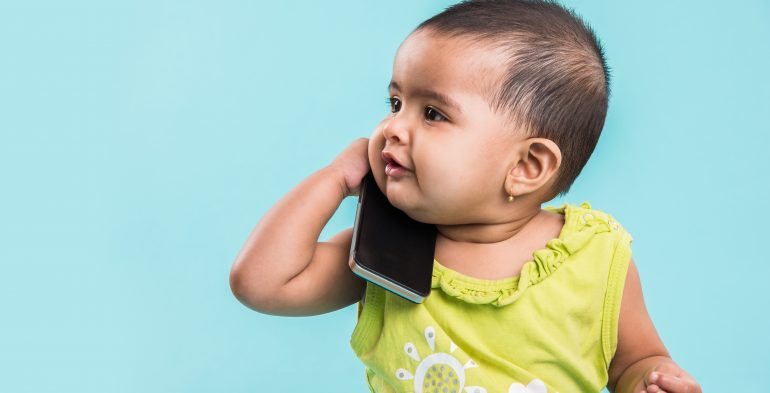
When do infants speak their first word. So when do babies usually say their first word. As a general guideline a baby might say her first few words close to her first birthday. The average age at which kids utter their first real word is around the one year mark.
Mostly children learn to talk during their first two years of life. Uses inflection for example raises her voice at the end of a question like more and makes hand gestures to complement her speech. They can first pronounce the world like mamma and dadda.
By the end of this second year many but not all babies may be able to say dozens of words. How Babies Learn Their First Words Like teenagers babies dont much care what their parents say. They will not understand the meanings probably at the stage of 8 months.
Throughout the world infants are typically speaking their first words by 11-13 months and research suggests that most babies show major improvements in their ability to understand speech by 14 months Bergelson and Swingley 2012. When do babies say their first word. At about 10 months shell gain more control and combine sounds even using her own invented words.
After 9 months babies are able to understand some common basic words. When Do Babies Say Their First Words. Within a few months of understanding that there are individual words tucked into that jumble of sounds hes hearing every day your baby will start to experiment with making sounds of his own.
Around 12 months according to experts. Most children speak their first word between 10 to 14 months of age. During that time your babys speech development depends on your.
Most toddlers produce their first spontaneous two-word sentence at 18 to 24 months usually once they have acquired between 50 and 500 words. Most babies usually start speaking at 11-14 months probably around their first birthday. And by the time your baby turns two he will already be putting words together to form sentences a bit broken though.
Knows one or more words well enough to use them. Some take those first tentative steps as early as 7 or 8 months while others might not hit their stride til theyre 18 months old And when it comes to talking the same wide range holds true. They will be simple and not.
Before their first sentence they often achieve the effect of complex expressions by stringing together their simple words. Long before he utters his first word hes learning the rules of language and how adults use it to communicate. However this varies from individual to individual.
If your child isnt saying any words by age 15 months bring it up with her doctor. Listen for baby words like baba dada and yaya. Though they are learning words at 10 months old infants tend to grasp the names of objects that.
Your baby learns to talk during his first two years of life. Parents should be hearing vowel and consonant babbling by 8 or 9 months and. Development Milestone emerges from age 5 to 9 months.
And very soon those sounds become real words. By about 6 months your baby will most likely understand individual words such as his name and the names of other people and familiar objects. Critical milestones for a baby learning to talk happen in the first three years of life when a babys brain is rapidly developing.
By the age of two babies can generally form two word sentences such as doggy nice The dog is nice or got boo-boo I got hurt. If your baby 12 month old is babbling making eye contact responding to her name showing joint attention using gestures and pointing but does not have any words keep doing what you are doing. After the first few months of baby babble your baby begins to say random words.
Even though your child isnt saying many words theyre babbling a lot and attempting to imitate the sounds of others. Usually at 12 months they talk for the first time. Says his first word.
Then in your babys second year her vocabulary may expand slowly in the beginning and pick up toward the end. First words to teach your infant. Some babies speak their minds with a real word or two around 10 or 11 months yet others stay mum until well after their first birthday.
Starting at birth babies are listening closely to the words and sounds all around them and beginning to sort out their meanings. Your baby will start using his tongue lips palate and teeth that come out to make sounds. Remember the average age that babies start talking by talking I mean say their first word or 2 is around 12 months.
The ability to control bowel and bladder muscles comes with proper growth and development. There is very little control between 12 to 18 months.
 Infant Potty Training What It Is And How To Do It Babycenter
Our brain learns that it can control when the bladder contracts and also stop it from contracting.

Why can t babies control their bladder. When wetting happens in a child who is old enough to control his or her bladder its known as enuresis. Less often a medical condition can cause wetting. Granted babies arent miniature adults.
Wetting at night is. During pregnancy your growing baby can place a lot of pressure on your bladder. By 2-3 years old the child gains control over the sphincter and pelvic floor muscles and can hold back the flow of urine until they reach a toilet.
I had a 3rd degree perineum tear and sulcus lacerations - two weeks later almost and I still have absolutely no bladder control. This can lead to urine leakage incontinence. Its a type of dysfunction that can accompany overactive bladder but is usually unrelated to it.
For example in one study researchers found that only 20 of children attained complete bladder and bowel control by the age of 2 years Largo et al 1978. This is why they have such little bladder control and the reason for some frequent peeing. If you have had this experience you know that it can cause personal distress as well as embarrassment.
First the bladder can simply hold more urine with age. As children get older they become more able to control their bladder. This means that if you leave your puppy in a crate overnight without potty breaks he will definitely make a mess in it because he is not physically capable of holding it in until you wake up in the morning.
Doing regular Kegel exercises can help treat this condition. Urinary incontinence is the loss of bladder control. I go through diapers faster than the baby.
Pregnancy and childbirth also may contribute to bladder control problems because of the following conditions. What causes daytime wetting in children. Children gradually learn to control their bladders as they grow older.
What causes bladder control problems in children. In children under age 3 its normal to not have full bladder control. This type of brain control of the bladder is how children should become potty trained.
Holding urine too long. Peter Dazeley Getty Images. Overflow incontinence is often caused by an obstruction or blockage in your bladder which prevents it from emptying fully.
Damage to the nerves that control the bladder The fact that the urethra and bladder. Learn which children are more likely to have bladder control problems. Bladder control problems can happen both during pregnancy and after childbirth.
There are a number of causes of incontinence including illnesses previous surgeries childbirth infections medications and weight gain. Most children are unable to obtain bowel and bladder control until 24 to 30 months. As we get older we start to learn to block this reflex through signals from our brain.
Urinary incontinence is the sudden loss of bladder control. The fact that the urethra and bladder have moved during pregnancy. Problems that can occur during this process and lead to daytime wetting include.
Total incontinence may be caused by a problem with the bladder from birth a spinal injury or a small tunnel like hole that can form between the bladder and a nearby area fistula. Your childs bladder can overfill and leak urine. Bed-wetting occurs when a child cannot control his or her urination at night.
These children are started on a timed voiding schedule such they try to go to use the restroom every few hours regardless of their perceived urge to urinate. They cant control elimination to the extent that we can. Overactive bladder is one common cause of bladder control problems especially among women.
As infants grow several things allow them to gain control over the act of urinating. These exercises also called pelvic floor. After pregnancy incontinence problems may continue because childbirth weakens the pelvic floor muscles which can cause an overactive bladder.
A child younger than 12 months of age has no control over bladder or bowel movements. Bathroom habits such as holding urine too long and slow physical development cause many of the bladder control problems seen in children. Children develop at different rates.
But infant potty training does not require complete control. The age at which children gain brain control over their bladder varies. Causes of bladder control issues can include pelvic organ prolapse weakened pelvic floor muscles and damaged pelvic nerves.
Your childs bladder squeezes without warning causing frequent runs for the toilet and wet clothes. I stand I empty. Accidental wetting with underactive bladder is caused by when the bladder becomes too full and overflows.
The bladder can become so. Damage to the nerves that control the bladder. Sometimes a child can hold the bladder so much that he exercises the muscle and makes the bladder stronger which isnt a good for the urinary system.