10-13 hours including naps Age 6-12 years. According to the American Academy of Pediatrics AAP here are the current sleep recommendations for kids at different ages.
 Newborn Sleep Patterns And Schedules For The First Year
Shell typically snooze in short spurts of two to four hours waking to be fed burped changed and soothed.

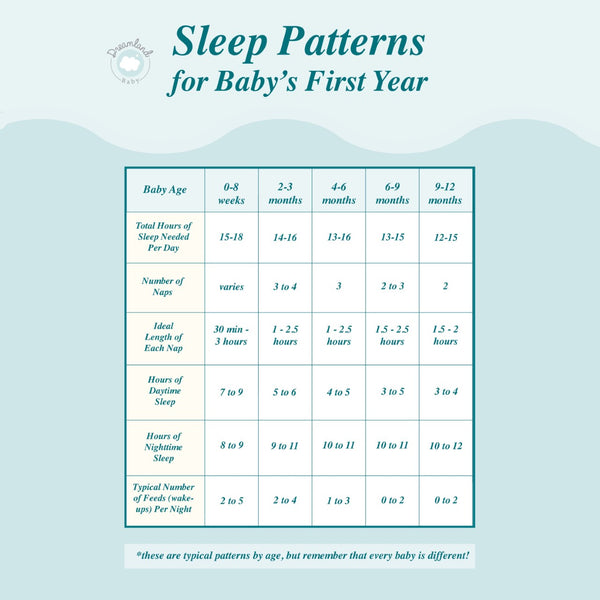
Baby sleeping chart age. Generally newborns sleep about 8 to 9 hours in the daytime and about 8 hours at night. At this age theyre still developing and feeding often at night. Heres a quick look at two ranges of sleep during the first year.
From 6-12 weeks this amount becomes 35 - 45 hours. But as your baby gets older you may be wondering how much your baby should be eating how often and how many ounces by age. But around 4 months of age you may see a brief return to more nighttime wake-ups as your baby works on developing more adult sleep patterns.
As they move from toddlers to school age their sleep becomes increasingly similar to that of adults. By Nicole Johnson Founder and Lead Sleep Consultant in Baby Feeding. Total Hours of Sleep.
Newborns need to eat frequently and will wake round the clock to feed so a fixed bedtime is obsolete at this age. Some not all babies this age can sleep for long stretches of six to eight hours at night. About 16 to 17 hours.
Wake Time Bedtime Notes. Watch your babys sleep cues closely and put down for sleep at the first signs of tiredness. 4-6 Month Sleep Tips Babies this age will start to quit nighttime feedings and are usually ready to sleep through the night now anywhere from six- to 12-hour stretches.
As Im sure you are aware the worlds pre-eminent sleep researcher on children Dr. Your baby may start skipping one feeding in the middle of the night. By 56 months of age babies are capable of lengthening naps though may need nap assistance to learn that skill.
The Pediatric Sleep Council was created to provide accurate and up-to-date information on sleep in young children for parents. Oversleeping feeding and sleep Up to 6 weeks of age babies should be having a cumulative total of between 45 - 55 daytime nap hours. If your child is sleeping from 8pm-6am try bringing the bedtime earlier to about 7 pm or even earlier gasp and presumably when they sleep 7 pm-6 am or even 6 pm-6 am they will have magically maximized their sleep.
Ferber Director of The Center for Pediatric Sleep Disorders at Childrens Hospital Boston a Professor in the Department of Neurology at Harvard Medical School states for example that a 6-8 months old on average sleeps 125-135 hours of sleep per day on average with night time sleep on average being 925 hours and daytime sleep being 325 hours in total. For older babies 4-12 months the Academy has advised that babies who get 12-16 hours every 24 hours are less likely to experience behavioral problems Paruthi et al 2016. 225 hours awake time between naps.
How Much Sleep Do Kids Need. On 3-nap schedule third nap is shortest 3045 mins. Newborns typically sleep in short cycles of 2-4 hours throughout the day and night.
By 3 months of age babies can be sleeping around 15 hours over a 24 hour period. The goal is to provide comprehensive and expert-based information on baby and toddler sleep that is freely available to the public. Most babies dont start sleeping through the night 6 to 8 hours without waking until they are about 3 months old or until they weigh 12 to 13 pounds.
At 4 months old single sleep cycle naps 3045 minutes are still normal see our Naps 101 series. 11-14 hours including naps Ages 3-5 years. By six months its probably around 16 hours a day and by 12 months your baby likely sleeps about 12 hours between overnights and 1-2 naps.
9-12 hours None 10-12 Months 6-8 PM. Though more alert and social most babies this age still take three to four or even more naps a day. In this process the sleep requirements for young children decline and that is reflected primarily in a decreased amount of time spent napping during the day.
The fourth trimester You were probably told that. Most take about three daytime naps. The amount of sleep that kids should get changes significantly as they get older.
2-4 hours 3-4 times per night 4-8 Months 6-730 PM. Baby Feeding Chart How Many Ounces By Age. Research shows about 60.
12-16 hours including naps Ages 1-2 years. Newborn to 3 months. This decreases slowly but steadily.
Bedtime will inch earlier as you approach the 4 month mark. As a result the American Academy of Sleep Medicine has declined to offer concrete recommendations for sleep duration in babies under 4 months of age Paruthi et al 2016. As newborns babies seem to eat sleep and poop all day every day.
Actually its around 18 hours initially with the other time devoted to eating burping diaper changes and probably some crying. 6-8 hours 0-1 times per night 8-10 Months 6-8 PM. A healthy baby in this age range should get a total of about 14 to 17 hours of sleep over the course of a 24-hour day.
Around two-thirds of babies truly sleep uninterrupted for that blissful 6 to 9 hours by the time theyre 6 months of age. But they may not sleep more than 1 to 2 hours at a time. Age Bedtime Duration of Sleeping Periods of Awakenings 0-6 Weeks NA 15-35 hours 4 times per night 6-15 Weeks 8-11 PM.
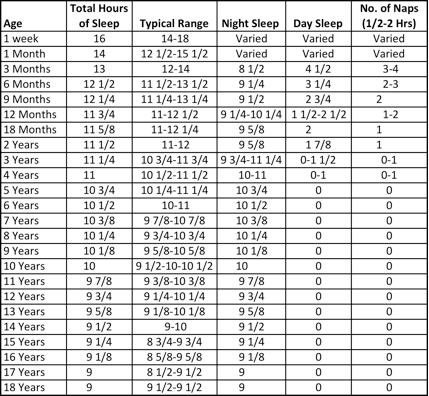
Age Total Sleep Avg.
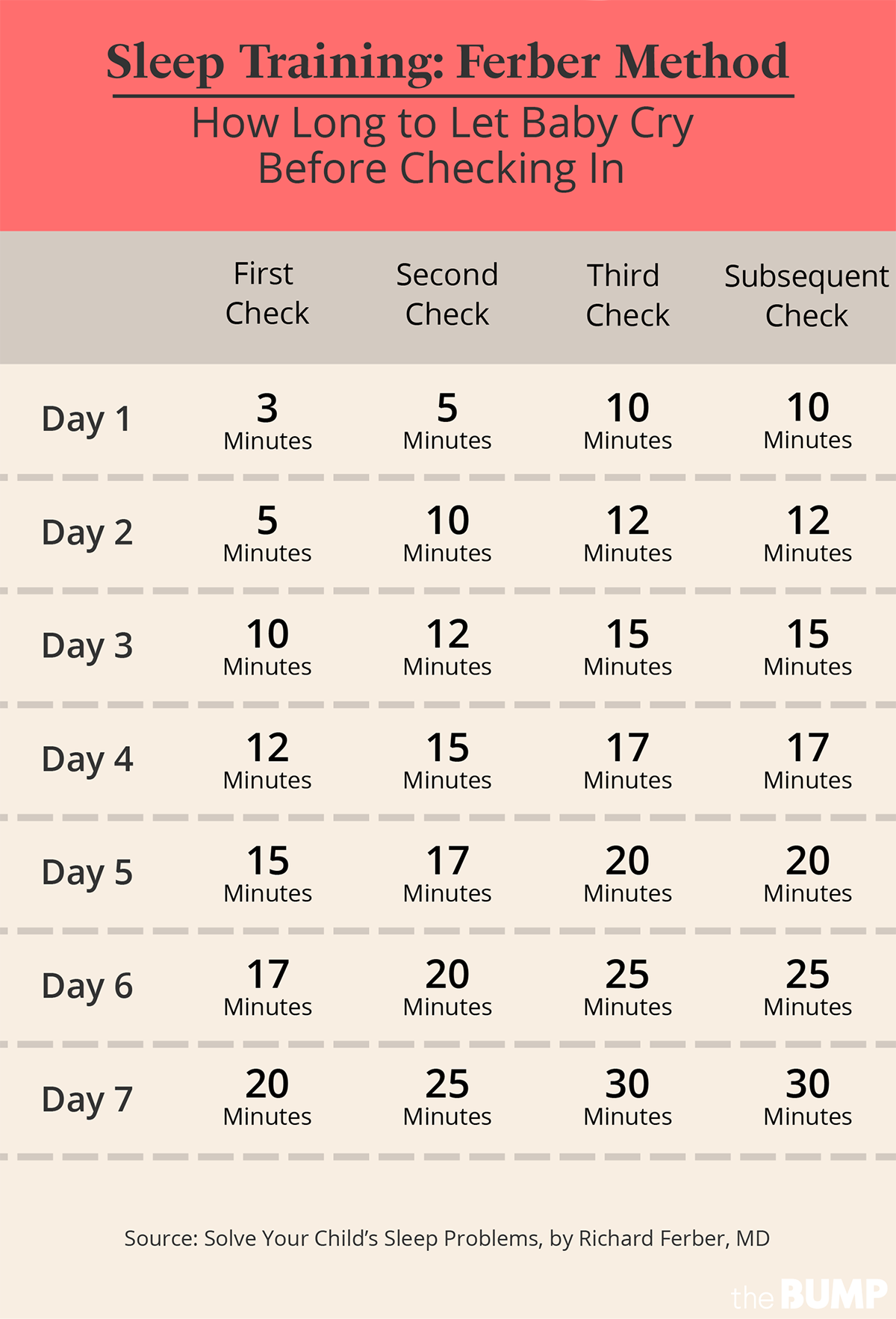
Day 71st wait period-20 2ndwait period-25 3rd wait period-30 remaining wait periods-30. The strategy known as the Ferber method also called graduated extinction was designed to help babies learn to self-soothe and fall asleep on their ownor fall back to sleep independently.
 The Ferber Method Explained
Facts and fiction below.
Ferber sleep chart. Over the years Ferbers method of sleep training has sparked controversy among parents pediatricians and sleep experts alike. If by day 7 thing are improving but still not better just continue adding a few minutes onto each interval of time. Here Are The Ferber Method Chart Day-1 Of Ferber Method.
This method involves letting your baby cry at increasingly longer intervals until they are sleeping through the night and taking longer naps. Ferber is an associate professor at the Harvard Medical School and the director of the Center for Pediatric Sleep Disorder at the Boston Childrens Hospital. Heres everything you need to know about this sleep training method.
1st wait period-17 2ndwait period-20 3rd wait period-25 remaining wait periods-25. 3 minutes Second Wait time. The Ferber Method essentially involves letting your child cry himself to sleep so he will learn to sleep through the night.
So the first part of the Ferber method is that you make sure that you arent one of your childs sleep associations and that you dont hold rock or talk to your child as he goes to sleep etc. This can include a bath a story or whatever activity is calming to the child. Here are the steps to implement the Ferber Sleep Training Method of getting a baby to sleep.
Sleep 1997-06-01 View full abstract on Pubmed. 10 minutes Third Wait time. Some swear by the Ferber approach while others claim that it creates lifelong emotional scars.
His Ferberizing approach was first made popular in his 1985 book entitled Solve Your Childs Sleep Problems which has since been updated and revised. Read all 136 questions with answers advice and tips about ferber sleep chart from moms communities. Chesson AL Ferber RA Fry JM Grigg-Damberger M Hartse KM Hurwitz TD Johnson S Kader GA Littner M Rosen G Sangal RB Schmidt-Nowara W Sher A.
Therefore if you plan to implement The Ferber Method exactly as outlined without night feedings then I recommend you wait until your baby is capable of going 11-12 hours without consuming milk. If your child cries or calls out for you at bedtime youll wait for a period of time see the Ferber Method chart before you check in on them briefly. Additional notes about the Ferber Sleep Training Method.
The Ferber method is considered to be a gentler option since it involves periodically checking in on your baby when shes crying. Ferber Sleep Training Graduated Extinction Definition Dr. For the full method see Solve Your Childs Sleep Problems by Richard Ferber.
4 minutes Third Wait time. 5 minutes Second Wait time. 10 minutes Subsequent Wait time.
Ferber calls it the progressive waiting approach. This can also be used to compel the baby to take longer naps. But as Bourne points out it can also be personalized if you feel the precise time frames arent right for your family.
Create a bedtime routine to follow every night. Rubbing his back letting him listen to music or drink a bottle of milk or juice or any other condition that you child cant reestablish on his own in the middle of the night would be other poor sleep associations. During the check-ins youll go to your baby at timed intervals that gradually get longer until she falls asleep.
The check-ins also get longer on subsequent nights. If the child should wake up during the night repeat the same steps as above. The Ferber sleep method is a training tool that will help your baby adjust to a normal routine of sleep and wakefulness.
A bedtime routine will begin to teach the child when sleep time is coming. The Ferber Method or simply Ferber is a sleep training regimen introduced by Dr. Keep in mind that based on my 10 years of experience as a sleep consultant working with families personally when a baby can sleep all night without feedings varies significantly especially if you are breastfeeding.
Richard Ferber is a pediatrician and the director of The Center for Pediatric Sleep Disorders at Boston Childrens Hospital. Some of the advice from Moms is. Say goodnight and leave the room.
10 minutes Second Wait time. Results from this method can begin to show as early as the first day and usually within just a few days. Ferber says to NOT feed your baby at night after 3-4 months old.
After your childs bedtime routine place your child in their sleep space while they are still awake. In the book Dr. This Ferber method chart was first published in Dr Richards book Solve Your Childs Sleep Problems.
12 minutes Subsequent Wait time. Download a Baby Sleep Chart. One of the most popular sleep training methods is The Ferber Method also known as Ferberizing or graduated extinction.
The Ferber method of sleep training is a fantastic short-term tool for children over the age of 4-6 months old who require extensive comforting at bedtime or who have other negative sleep associations that need to be addressed in order to improve sleep quality and quantity. Its also often exaggerated and misunderstood. Richard Ferber in 1985 in his book Solve Your Childs Sleep ProblemsThe book was last updated in 2006Dr.
3 Year Old Sleep Issues 4 Month Old Who Just Doesnt Want to Sleep How to Get 6 Yr Old to Sleep by Herself. It details the recommended check-in times and how to make these intervals longer gradually as you progress through the sleep training routine. The Ferber method consists of a very specific set of instructions outlined in the book see chart below and its most effective when its followed exactly as described Schutzbank says.
I use this sheet along with my green yellow and red behavior system. Following directions personal space appropriate wordsnoises respecting school community staying on task and stay in assigned area.
 Social Skills Cards And Behavior Management I Would Link This To My Class Wide Behavior Management Syste Social Skills Student Behavior Chart Student Behavior
Other skills addressed in social skills groups might include using appropriate greetings in conversation practicing how to make a request or a command using appropriate facial expressions and gestures in conversation standing at an appropriate distance during a conversation etc.

Social skills behavior chart. I connect this to the color chart. All the points in a section stay on blue or move up. One way to help students develop strong social skills is by using behavior charts in the classroom.
__ displays an enthusiasm for learning. Weve been working a lot on social skills with my son. Strive to be independent and may start emotionally distancing from caregivers.
__ is a leader and a positive role model for other students. I get excited to see what will be next for my son. The PKBS Merrell 1994 is a 76-item behavior rating scale that measures social skills and problem behaviors of children between the ages of 36 years old.
Behavior Social Skills Goal Bank Classroom Skills Following Instructions Getting the Teachers Attention On-Task Behavior Group-Work Being Prepared Interacting with Others Friendship-Making Conversation Dealing with Conflict Activities Skills for Dealing with Feelings Alternatives to Aggression Classroom Skills Following Instructions. To be successful within social exchanges one needs to be able to accurately decipher both verbal and. Body Language cards - Students take turns selecting a card and determining how they would feel in the given situation.
__ is respectful and considerate. Social skill is the ability to behave in an acceptable manner in social situations. This could be as simple as notes back and forth that are read aloud to your child in which her appropriate behavior is praised or as elaborate as a reward chart that is used both at home and at school.
Social skills training SST is a type of behavioral therapy used to improve social skills in people with mental disorders or developmental disabilities. This simple behavior chart is an easy way to keep families informed and hold children accountable for their classroom behavior. Behavior Chart With primary reinforcer Feeding Data Sheet.
Some children and adults with special needs struggle in the area of social interactions. Your search for social skills worksheets ends here. Due to his hyperlexia and autism we have to teach him directly about social skills concepts that develop in most kids naturally.
SOCIAL SKILL INSTRUCTION EFFECTS Effects of Social Skill Instruction yPower Ratings Prosocial Behavior Small Problem Behavior Small Specific Behaviors Anxiety Medium Adjustment Small Cooperation Small Interaction Small Self-Concept Small Aggression Small Rutherford et al 2004. At the end of the day each child colors their chart to show their daily behavior. Target a variety of social language skills with this packet that includes.
SST may be used by teachers therapists or other professionals to help those with anxiety disorders mood disorders personality disorders and other diagnoses. __ demonstrates positive character. Spend a lot of time with friends and may be interested in dating.
__ has a positive attitude towards school. I am grateful for all of you and I feel so blessed. Show pride in successes.
Youre a team of people who really love my son and do all they can to help him and educate us. Behavior charts are successful because they specify concrete skills breaking them down into. So to make sure we dont miss anything important I put together this list of basic social skills for kidsAnd yes it includes a free printable cheat sheet so you can reference it at any time.
Reinforce prosocial skills such as sharing empathy cooperation by asking a child to do things like help care for a baby collect food for a shelter. The author indicates that the PKBS can be completed by teachers parents day care providers or others who have sufficient exposure to a childs behavior to provide accurate ratings. The kids get up to 6 points for each section of the chart.
These difficulties may be influenced by deficits in self-regulation processing analysis of spatial information and cognitive flexibility. See more ideas about Social emotional learning Social skills School social work. Provide opportunities for your child to develop an understanding of rules by playing simple table games that rely on chance rather than on skills such as cards dominoes tic-tac-toe.
Sep 30 2020 - Explore Janice Seras board Individual behavior chart on Pinterest. Start trying to discover strengths and weaknesses at times seeming self-centered impulsive or moody. __ makes a sincere effort and works hard in class.
Behavior General Conduct and Social Skills. __s in-class behavior is excellent. Social skills includes the ability to read and interpret body language cues and facial expressions.
24 body language cards 24 giving information cards 24 perspective taking cards and 24 inferring cards. Teaching social skills should be integrated regularly both at home and at. Behavior and social skills are our primary focus including appropriately expressing feelings and needs including using words when upset playing well with other children following directions respecting our own and each others bodies and personal space taking turns sharing cleaning up and paying attention to tasks.
If your baby is breastfed the general rule is that most newborns need between 20 and 30 ounces of breastmilk and between 25-35 ounces once theyre past the newborn stage. 9 to 12 months.
 Feeding Baby How Much Should A Newborn Eat
Dont expect your baby to finish a meal.
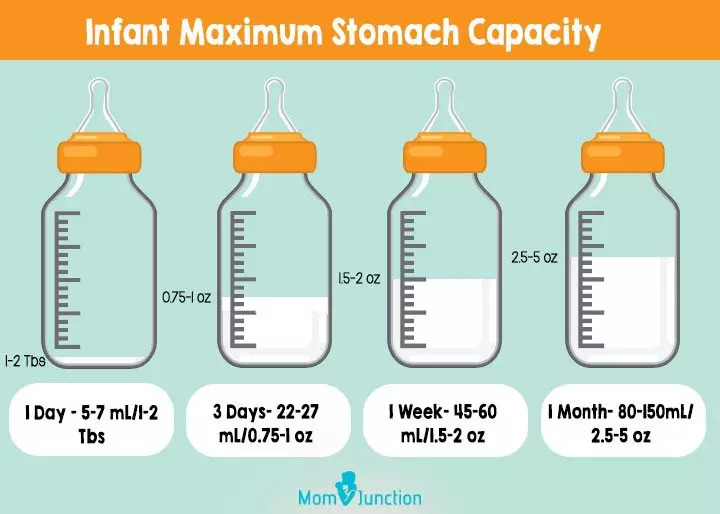
Newborn eating chart. As your baby grows his or her belly grows too. Baby Feeding Chart at a Glance. As your baby gets older and is eating more solids you will gradually increase the portion sizes.
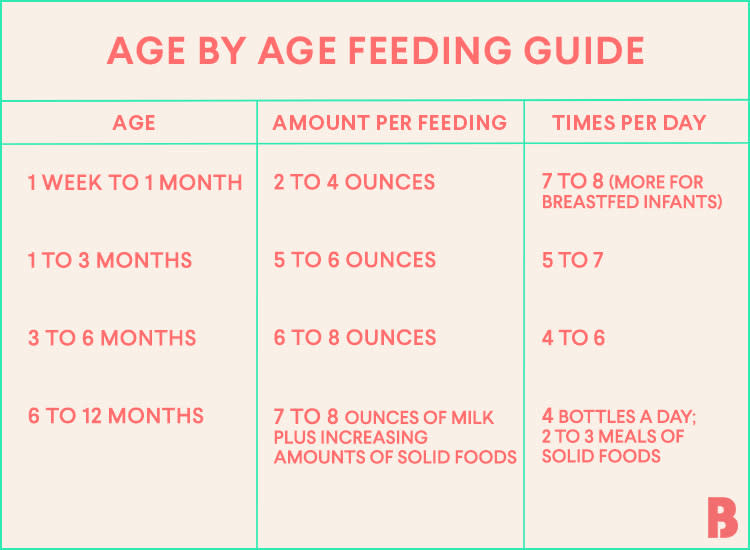
Babies will probably only eat 12 of a tablespoon portion of food the very first times you begin solids. Infants should drink breast milk andor formula for the first year of life. Once they turn 6 months old they may take up to 8 ounces every four or five hours says the AAP.
You can also add your own notes if you want to add so you can discuss it afterward. Expect to add about an ounce per month until baby is eating 6 to 8 ounces of formula at a time which usually happens when baby is 6 months of age. Your baby will be able to drink more infant formula at each feeding and the time between feedings will get longer.
Canned foods may contain large amounts of salt and sugar and shouldnt be used for baby food. Start with a very small amount 1 to 2 teaspoons of a single-ingredient puree. Picking up on your babys hunger cues helps you know when hes ready to eat or have some more.
Fortunately you dont have to. On average thats about every 2 to 3 hours. By 8 months or so babies often have three meals and start adding snacks.
Heres a handy baby eating chart summarizing how many ounces of milk a baby should be getting depending on the situation. Baby will likely get hungry every three to four hours eating about 2 ounces per feeding as a newborn and progressing to 4 ounces by the end of the first month. Most infant formula-fed newborns will feed 8 to 12 times in 24 hours.
Your babys growth and development depend on a large consumption of fat and calories. Around 14 to 12 cup of dairy foods a day. When your little one reaches 6 months you may even start feeding him tofu.
Begin offering breast milk andor formula in a cup starting at 6 months of age. Signs baby is hungry. Every 2 to 3 hours.
Plus taking notice of his early hunger signs means you can get him fed before he. Always wash and peel fruits and vegetables and remove seeds or pits. A typical feeding schedule may look like this.
If you are bottle feeding you should record how many ounces she drinks each time by writing 25 oz or 3 oz etc. As you watch for those delightful baby milestones from first smiles and giggles to sitting and crawling it can be hard to keep track of everything related to your babys feeding schedule. Popular first foods include pureed mango banana chicken turkey beef peas sweet potatoes and infant cereal.
Gradually increase to 1 to 2 tablespoons of food once a day. Like breastfed babies bottle-fed newborns should eat on demand. Weve assembled all the necessary details in the chart below including feeding.
This nutrition chart from WebMD shows what solid foods your baby should be eating at each stage of the first year and how to prepare them. Remember this is a new experience for your baby. For example an 8-pound baby would need about 20 ounces of formula in a 24-hour period.
The baby feeding and diaper chart is maintained on three levels. These baby feeding charts for breastfeeding babies formula-fed babies and solids will help guide you to know if your baby is eating enough and how to help your baby sleep through the night sooner rather than later. Around 14 to 12 cup of protein-packed foods a day.
Simply multiply your babys weight by 25. 16 to 30 ounces of formula or milk or three to five nursing sessions a day Around 14 to 12 cup each of grains fruit and veggies twice a day. Dont use salt or sugar when making homemade infant foods.
If you are breast feeding youll want to record how long on each breast. The amount of feeding to include on your baby feeding log for this age is around a teaspoon of pureed fruits or cereal mixed with up to 5 teaspoons of breast or formula milk. Continue to offer a wide variety of fruits vegetables grains and protein-rich foods.
When introducing juice offer 100 pasteurized juice and limit it to 46 ounces per day. Obviously the main reason for the baby feeding schedule is to record when you feed your baby and for how long or how many ounces. Start with dry infant rice cereal first mixed as directed followed by vegetables fruits and then meats.
Fruit juice is not recommended under 1 year of age. This is the record of feeds a baby takes in one day the time of the feed given to the baby the amount given usually in ounces and the duration in which the baby finishes the feed. Talk with your childs doctor or nurse about how much infant formula is right for your baby.
Follow your babys fullness cues. Fillable and printable Baby Feeding Chart 2021. First Weeks and Months.
As your babys eating skills improve gradually introduce more textures and soft finger foods. Indeed babies should still drink about 4-6 ounces per feeding when theyre 4 months old. As time goes by you can increase the amount one teaspoon at a time.
Follow that curved line until the end where the percentiles are written on a white shaded background. Children reach milestones in how they play learn speak act and move crawling walking etc.
 Baby Growth Stages First Year Page 1 Line 17qq Com
Every month your child is learning something new.
Baby development chart first year. They move from not being able to control limb movements to being able to reach for things and bang them together. Heres your guide to your babys first year and all its major milestones first smile giggle step words challenges colic and teething and diaper. Check the milestones your child has reached by the end of 1 year by completing a checklist with CDCs free Milestone Tracker mobile app for iOS external icon and Android external icon devices or by printing the checklist pdf icon 300 KB 2 Pages Print Only below.
Trial and error problem solving. Relaxes arms and legs from the tight fetal position. Coos curious and interested in environment 6 mo.
Keep track of your babys first years milestones. First Year Infant Development. Click on the age of your child to see the milestones.
Developmental milestones are behaviors and physical skills children reach and master as they grow. Stairs first then down Sensori-motor. This development occurs rapidly and it is important for you to understand t as parents so that you can ensure your baby remains healthy and happy.
In the first two months your babys vision is pretty fuzzy so they will enjoy close objects within 30 inches. Babbles and imitates sounds 9 mo. Babies in the age group of one to six months undergo physical psychological and cognitive development.
Skills such as taking a first step smiling for the first time and waving bye bye are called developmental milestones. In the example above the child is a boy who is 12 months old and weighs 23 pounds. Print this developmental milestone chart and check off each milestone as your child grows into her first year of life.
Cooing sounds begin to be more organized jabbering by the end of the first year. Youll see how your baby can hold her body higher and higher every day. Babys hearing is completely developedAs a result heshe may even recognize and respond to the Mothers voice.
For all new parents it is best that you go with your gut feel. Growth charts show normal ranges for babies of the same age and sex and tell you what percentile your child is in. Babies develop very quickly during the first year of life.
From the time your baby is born her weight length height and head circumference will be charted to make sure her growth is on track. Babies develop the most during their first year. Take the checklist with you and talk with your childs doctor at every visit about the milestones your child has reached and what to expect next.
A Week-by-Week Guide to Development While every baby develops at his own pace experts can guess when certain milestones are likely to happen. Its important to remember that babies develop at different rates and this printable represents general guidelines. Below are the major milestones youre likely to see during your babys first year.
This baby is in the 75th percentile meaning 75 percent of 1-year-old baby boys weigh less and 25 percent weigh more. Complete development chart from 0-12 months. Discriminates between parents and others.
BabyCenter presents Growth charts and your babys first year. Or possibly your neighbors eleven month old is walking but your thirteen month old has not attempted to walk. Must know Developmental Baby Milestones seen in the First Year.
Maybe you are worried that your babys development is not where. Fiftieth percentile means your babys size is average. Your baby loves being held hugged and massaged as touch is an important part of his or her social well-being.
Your babys growth and development during the first year is both delightful Those coos. For the beginning few weeks the babys hands will mostly be fisted. Those cuddles and dizzying with all the crying and feeding and diapering youve got your hands full.
Sucks swallows and breathes while feeding. Developmental milestones are things most children can do by a certain age. By one year your baby should be sleeping less during the day and more at night.
And walking may start anytime between nine and 18 months. Physically explores environment to learn about it. This is where growth milestone charts come into the picture.
In addition to the above mentioned points here is a chart that represents the complete month wise developmental changes that you can expect in your little one including pointers for physical growth. One Year Baby Milestones. 3-month-old babies typically sleep 15 hours a day in longer stretches and take 3 naps a day.
Some first-year-of-life physical milestones include. First-Year Milestones Month 1-2. Dont forget about tummy time.
Some babies may say their first word at eight months while others dont talk until a little after the one-year mark. By giving your little one some time in her belly shell be strengthening her core arm and neck muscles. Baby Growth Development Baby Milestones Chart.
Repeats movements to master them which also stimulates brain cell development 4-5 mo. Rooting turns head and seeks breast Lifts head momentarily about 45 degrees when lying on stomach. Perhaps your six month old has not rolled over yet but the infant development chart shows that some babies start rolling over at five months.