When Ainsworth published the first results of the SSP in 1969 it seemed a completely novel and unique in. It is not possible to relia-bly score the procedure by observing it as it occurs.
 Strange Situation Activities
In 1964 when the first wave of her sample of infants were 11 months old Ainsworth attempted a study to cleanly distinguish prompts for behavioural systems.

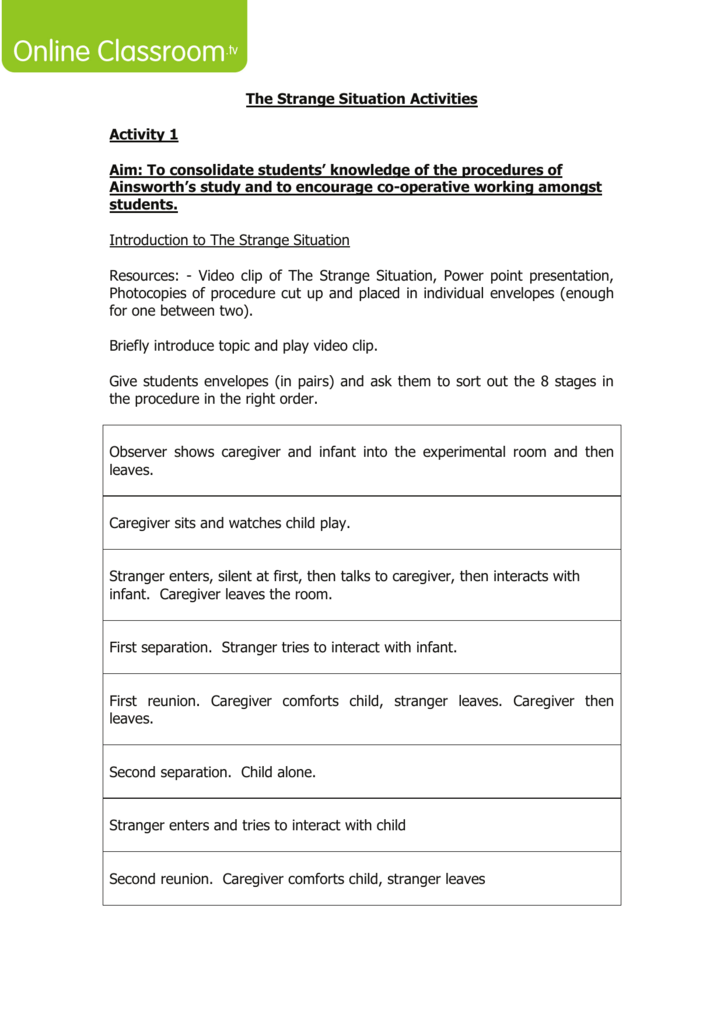
Strange situation procedure. Stage 3 Stranger enters and attempts to interact. The Strange situation is a standardized procedure devised by Mary Ainsworth in the 1970s to observe attachment security in children within the context of caregiver relationships. Stage 5 Mother enters and the stranger leaves.
What Is The Strange Situation. Stage 2 The child is encouraged to explore. Stage 6 Mothers leaves.
The video record should provide information about the context when some one enters or leaves what the adults are doing if it attracts babys attention etc. Its objective is to study the interaction that a mother or an adult stranger maintains with the child in an unfamiliar environment. The hallmark of infant attachment is using one or a few people as a secure base from which to explore and as a haven of safety when needed.
It applies to infants between the age of nine and 18 months. In 1978 to measure attachment. The American-Canadian psychologist Mary Ainsworth 19131999 developed the Strange Situation Procedure SSP to measure mother-child attachment and attachment theorists have used it ever since.
Looked after siblings About 80 per cent of the population have at least one sibling and this seems to hold true for children in the. Parent or caregiver enters room with child child explores for 3 minutes A Stranger enters and joins the parent and infant talks to mother Parent leaves the infant with the stranger. 1000 words Part 2 DE100 project report Write the Design Participants and Materials subsections of the Method section of your DE100 project report.
The Strange Situation Procedure reference shortened to Strange Situation in this evaluation is a procedure used to study attachment in children. In the original study 10-to-24 month old infants were subjected to a strange setting which involved the parent briefly leaving the child alone in a room and then returning then a unfamiliar female entered the room and the parent leaves the child for a second time but this time the child is left in the room with the unfamiliar female. In the 1960s psychologist Mary Ainsworth created a standardized laboratory procedure called The Strange Situation experiment to observe an infants response to separations and reunions with the parent in order to identify early attachment security depicted in the Attachment Theory.
This essay will seek to give a basic background as to why Mary Ainsworth developed the procedure how it was developed and evaluate its. The Strange Situation Procedure SSP is increasingly being used to study attachment between dogs and humans. Ainsworth and her colleagues created a laboratory test that measured an infants attachment to his or her parent.
30 per cent of the mark Word limit. It applies to children between the age of nine and 18 months. The American-Canadian psychologist Mary Ainsworth 1913-1999 developed the Strange Situation Procedure SSP to measure mother-child attachment and attachment theorists have used it ever since.
This procedure was developed in year by Mary Ainsworth. Each phase of the procedure lasts 3 minutes and a session progresses as follows. 118 Strange here referred to.
70 per cent of the mark Word limit. 117 Van Rosmalen and colleagues documented that the term strange situation was already in circulation before Ainsworth to describe a procedure in which the responses of young children to an unfamiliar environment were observed and compared with other information known about the childs life. There should always be a sound and video record of the Strange Situation procedure.
Stage 4 Mothers leaves while the stranger is present. 400 words Part 3 reflective component Reflect on your writing. Part 1 essay Evaluate the usefulness of the Strange Situation procedure to our understanding of attachment.
The Strange Situation is a semi-structured laboratory procedure that allows us to identify without lengthy home observation infants who effectively use a primary caregiver as a secure base. The aims of this study were to assess how infants between 9 and 18 months behave under conditions of mild stress in order to test stranger anxiety separation anxiety and the secure base concept. The strange situation was a testing procedure created by Mary Ainsworth et al.
The test is called The Strange Situation Technique because it is conducted in a context that is unfamiliar to the child and therefore likely to heighten the childs need for his or her parent Ainsworth 1979. The goal of the Strange Situation procedure is to provide an environment that would arouse in the infant both the motivation to explore and the urge to seek security. The Strange situation is a procedure devised by Mary Ainsworth in the 1970s to observe attachment in children that is relationships between a caregiver and child.
The strange situation is a standardised procedure and the same method was used in all cultures however this procedure was devised in the USA based on their customs so may be ethnocentric There are a number of different variables that might affect findings in different cultures and therefore it is difficult to draw conclusions. The Strange Situation procedure is a laboratory process designed by American psychologist Mary Ainsworth in 1960. It has been developed from the Ainsworth Strange Situation Procedure which is used extensively to investigate attachment between children and their parents.
Strange Situation Procedure SSP commonly used to assess attachment in infants Ainsworth et al 1978 and pre-school aged children see Teti 1999 for discussion of the Crittenden and Cassidy and Marvin systems. The Strange Situation procedure developed by American psychologist Mary Ainsworth is widely used in child development research. Stage 1 Mother and child enter the playroom.